back to Part II
Altdorf
Altdorf is known for its 14th century resident, Wilhelm Tell. Besides showing off his marksmanship in the famous legend, his story is also about the roots of Swiss Confederacy.
On the wet evening the central square of Altdorf is quiet. Everything is closed except a convenience store. There is no rain but surrounding mountains are covered in mist.


The statue on the square is of course one of William Tell and his son.

After a short walk we go back to the car.


The drive to Lucerne goes through several tunnels. Switzerland has a truly amazing number of tunnels. The rain subsides, but when we enter Lucerne the floodgates open again 😡. It’s a good thing the hotel has an underground parking. Speaking of hotel, Lucerne turned out to be a tourist destination too, so I ended up reserving an Ibis Budget. We’ve never stayed in a 1.5 star hotels before. This one featured a bunk bed over a queen bed for 3 persons accommodation in a tiny room 😮. Quite effective actually! We don’t care about the space, we’re just here to sleep. Anne later said the bunk bed was more comfortable than all the sofa beds in other hotels.
Day 10
Lucerne
We start our explorations of Lucerne with a parking at the edge of the old city, and a breakfast in a nice cafe with some sandwiches, muesli and a rich looking plum pie (one of Toma’s favorites).
The old streets of Lucerne connect in frequent squares.

Stepping through the cobbled streets past the old houses adorned with decorations kind of calls back the old small town feel of Bern, kind of cozy, contrasting with a larger and more expansive Munich and hills, fortress and I think more luster of Salzburg. Come to think of it, both Munich and Salzburg were capitals of important principalities while the Swiss cities, although capitals of cantons, did not have heads of states residing here in palaces (despite calling them “residences” )


The old town clock tower has been here since the Middle ages.

Again we see a lot of houses with all kinds of frescoes, from simple geometrical shapes to full blown pictures.


This one commemorates Goethe staying in this hotel.

I mean, sure, I can understand that. I would say if one can’t make Roman style columns and statues going over the height of a building, it’s nice to have an option to at least paint them on 😄. Especially since it already has fancy bay windows and a golden plated statue.

At the end of the old city we reach the river Reuss.

We’re going to cross via Spreuerbrücke, a pedestrian bridge that has been here since 13th century, although it was only extended to reach the other bank in 1408. Although the bridge is only pedestrian now, people used to transport all kinds of things over it, as we see by the word “brücke” in it, as opposed to “steg” 🙂.


This wooden covered bridge certainly looks very mediaeval (in the best sense of the word).

It still has the original artwork series depicting the Dance of Death (made in early 17th century)

On the other side of the river we walk along the quay.


Here is another attractive oriel window.

This dam was built in the mid 19th century and can be used to regulate the flow of the river (which begins here, at Lake Lucerne). Reuss flows down to merge with Aare (which we saw in Bern) to join with Rhine later.

There are steps going into water nearby. I’m trying to shoot some ducks (photographically speaking), ladies and surroundings. The ducks got away 😄.

We step into Jesuit Church St Francis Cavier

By the time we exit shortly after, the rain is on again. Umbrellas up, at least our next stop is another covered bridge 😅. The bridge is Kapellbrücke and it’s the one you see on all photographs of Lucerne 😁. The name by the way comes from Kapellplatz, a square with a church not far from the bridge on the side of the old town.

Built in the mid 14th century, it is considered the oldest wooden covered bridge in Europe. Most of it, however, was burned in 1993 and restored a year later, so I think on average age of the parts Spreuerbrücke can give it a run for its money… Adorned with flowers, it certainly makes a very festive and attractive picture.


Upon crossing Kapellbrücke we complete our circle. But before we leave we need to do two more things here. The first one is visiting the Lion Monument, a sculpture, carved in a rock, commemorating the Swiss Guards killed while guarding the French king in 1792 attack on Tuileries Palace during French Revolution. The sculpture was created less than 30 years after the tragic event.
Unfortunately, the site is under a pretty heavy construction.

The second thing we have to do is feed me lunch because I only had muesli for breakfast. This we accomplish with a salad in a supermarket near our parking lot.
Mount Pilatus
The rain hasn’t been on for awhile, but it is very cloudy, so a mountain adventure may not be too great, but we’ll sure try. Both Toma and Anne wanted to take the world steepest cogwheel train rather than cable cars to Mount Pilatus, so we make a short drive drive to Alpnachstad, which is on our way anyway… We get to a ticket booth 5 min before the next train departure and here we are met with a shock – the prices are 72 franks per person 😤!!! Considering that the clouds are vast and we might not even see anything… But we’re here and might as well do it.
Frankly, figuring out the cost of transportation is something that we didn’t do but maybe we should have. There are several discounts for public transportation (like this cogwheel train) that can be found if one purchases some transportation pass. Since Tamara planned the trip with a car in mind, we have not looked at them, but there are options…
While the surroundings are beautiful, the cloudiness certainly doesn’t inspire much confidence in the view…


Not only the view from the top is cloudy, it starts to rain! On the plus side, the clouds seem to be moving rather swiftly, so maybe it’ll pass. We dive inside for a cup of tea.
Go figure, not only did the rain pass, but the clouds cleared up pretty nicely so it’s time to look around and take some pictures.


Some folks throw crumbs at the group of Alpine choughs, and I make some snapshots.


A walkway in the side of the mountain provides other observation points, but it’s full of puddles and the girls refuse to go there. I decide to go in but don’t go far.


That’s pretty much it for our tour of Lucerne. For some reason I thought we might see some details of the city from the mountain, but it’s actually way too far for that.
The way down is clearer and more enjoyable too, although there is still some mist lying on the slopes of the hills.


The drive to Interlaken is picturesque and entertaining, with a lot of beautiful views, some waterfalls visible across lakes and directions that look like this


Unterseen
Well, the truth is, although our planning concentrated on Interlaken, we actually won’t stay there. Today is Thursday and the next 3 days will be (you guessed it) Friday, Saturday and Sunday, and reserving hotels in Interlaken on a short notice for those days was challenging. I ended up reserving 3 different hotels for the next 3 nights, a compromise that having a car makes possible. Today’s hotel is in Unterseen, which is a town right north of Interlaken, also located between the lakes Thun and Brientz.
After dining in a nearby restaurant, we take a walk. Unterseen is a cute town full of alpine houses, with some views of distant snowy mountain peaks, though most of them are obscured by clouds.


South of the river is Interlaken, and we walked some there too. Frankly, we like Unterseen more, it’s quieter, less crowded.

It’s getting dark, and we get back to the hotel, taking another glimpse of the mountains.


Day 11
Schynige Platte
is a mountain ridge where one can hike and enjoy the views. After a nice breakfast we’re off to Wilderswil train station for another cogwheel train. Only this time it leaves before our eyes and we have to wait 40 min for the next one 😟. Combined with about 50 min that the train needs to get to the top, the commute this morning turns out quite long and by the time we arrive it’s past 11AM. The tickets are also quite expensive, though less so than for Mt. Pilatus. Cogwheel trains are probably expensive to maintain… The view from this train is just as good or better than the other.

There is a small botanical garden of the local flowers near the Schynige Platte station and we go there first. The burst of colors is very similar to what we saw on the Alpine slope of Krippenstein mountain in Austria, but even more concentrated. In the garden they are also accompanied by little tableaus introducing the flowers to us. This one we haven’t seen before, this is Edelweis, and for us also association with Sound Of Music.

The view of the snowy mountains and the valley to the south is gorgeous, and we embark on the trail that goes as a very elongated loop along the ridge.
There is a picture frame on the way

The views from the ridge of course has the obvious advantage: you can see both sides unobstructed and from a significant elevation. Once we reach the ridge we can see the lakes on one side and the mountains on the other. That means I can make a 360° panorama with both my wife and daughter being on the same trail on different sides of me 😆.

The ridge is about 2km above sea level, which is just a tad lower than 5fingers. We have not seen any glaciers at this height in Switzerland, but the view to the lakes is somewhat similar. Here is a view to Thunersee (Lake Thun). South of the river is Interlaken, north – Unterseen.

This panorama covers both lakes, with the ridge of Schynige Platte on the right.

The thing about mountainscapes, every time we move, the angle changes slightly so now there is a different picture 😃. I could post a 50 photographs of the this mountain chain (I won’t but there will be some 😉)


Among the mountains we see are the three 4 km giants, (from left to right) Eiger (Ogre), Mönch (Monk) and Jungfrau (Maiden). The idea is the monk is standing between the ogre and the maiden, protecting the maiden from the ogre. To me it is a little odd that the maiden is the largest of them, but I guess one man’s fish is another man’s ogre. Maybe people named them this way because Jungfrau has more snow and looks like it’s wearing white clothes, or maybe, as the largest peak, it was considered the best looking… Here are these characters with a big rock named Daube on the right and some silly hikers below.

Of course there is also plenty of flora and fauna around, especially on the way back that has more grass and flowers.


Since I have the full range of lenses with me, I can also enjoy the views of glaciers on tops of Alps.


There is a couple of alphorn players that give a mini-concert periodically at the train station. The sound of alphorn travels far, we heard them a little from the trail. Now we can hear (and see) them from up close.

Rather than going back down, we decide to have a lunch, figuring there might be a good view from the restaurant. However, all the shady seats in the restaurant are taken. That’s a deal killer for us right now but there is a cafe upstairs. Not the highest quality food but it’ll do for a lunch. And yes, the views are outstanding.


The only thing left is take the train down.

What with the hikes and the lunch and the wait for the trains and the “swift” cogwheel rides, the time is now firmly in the late afternoon area, and not only it’s a bit tight to plan and execute another hike, but none of us has a great desire to do so 😄. Instead, we decide to drive around Lake Thun and see some castles. Oddly enough, this will get us closer to our hotel too.
Our navigation sometimes makes curious gaffes. For example, sometimes it pronounces the German suffix for alley, “gasse” as it should be pronounced, sometimes – the same way as you would pronounce the English word “guess”. There is a street in Wilderswil called Obereigasse, so at some point the car navigation told us to “turn right to Ober I guess”. Of course we laughed and told it to get back to us when it’s sure 😂.
Thunersee
There are five castles around Thunersee, four in very good condition and can be visited, but by now they’re all closed. Nevertheless I think it would be cool to see them.
Spiez Castle (Schloss Spiez) is located in the town of Spiez, which again seemed to me kind of unimaginative – if you build a castle near a town, call it something else – but it turned out to be a real mediaeval castle, so no, the castle was built here first, the town – later. The town is called Spiez for the castle, which was built in 933 (the current tower – in 12th century).

Since we found a parking in Spiez, I look over a marina on the way back. By the way, the word “marina” comes from Latin for “sea” – “mare”. The Latin for “lake” is “lacus”… Was that a “lacuna” 😂? Speaking of bodies of water, this is the root of “lagoon”, which came to English from French…

The next castle is in Thun (the town that gave the name to the lake). The center seems to be busy and there were no parking that we see, so we decided not to stop here. Driving through it though, Thun seems to be an attractive town on Aare River, which, just like Rhine, also originates in the Alps and flows through lakes (in Aare’s case, both Brienzersee and Thunersee). We see the white Thun Castle (built in 12th century) from the road.

The third castle, Schloss Hünegg, stands right near the road. It’s a much later one, from 1860s. All we do is glance at it from the lake side.

From this angle we again can see, like in Austria, just how clean the water is in the alpine lakes!

The fourth castle is Oberhofen, another mediaeval castle that gave the name to the surrounding town. There is a restaurant inside, and some tents are coming up for some sort of event involving catering. We take a look and return to the car.


As you remember, looking for a hotel in Interlaken was not easy. Friday night was very challenging. What we decided to do is zoom out and expand our search. When we saw this hotel, we said: we have to do it! Perched on a slope of a hill north of Thunersee, it had inexpensive accommodations for three, parking and breakfast included. The only thing is… the only way to provide it was 3 single rooms 😅. Every room seems to overlook the lake and feature a balcony. And a restroom, which is not an automatic certainty in Europe 😉. Our thoughts were: it’s affordable, the view should be really good, the hotel restaurant also has good reviews, it’s a bit far but it’s not like we see better options closer… The name is Hotel Bellevue (literally, “beautiful view”), which I think is the most common hotel name in Alps, every town seems to have at least one 😆 (in this case the town’s name is Heiligenschwendi). The way there goes first through a small town with narrow winding streets, then through a rural landscape via narrow winding roads, and finally, after a weird narrow driveway, we arrive to the hotel. The old-fashion keys weigh a pound each probably 😁.
What can I say, this is the view. Beats our Bad Goisern hotel hands down.


After dinner we’re gathered on a balcony watching the sun setting behind the moutains.


There are farms nearby, as we hear the cow bells. Someone is grazing on the hills.

It’s already dark but I keep shooting photographs. Sorry, can’t stop…

Day 12
It’s the morning, so of course the hills are illuminated differently, so I make some more pictures from my balcony (that’s right, each of us has one)😀.


Lauterbrunnen
After breakfast we drive to Lauterbrunnen, a town in the valley we saw yesterday from above, and park the car in a huge parking lot. We won’t be using it today until we’re done with mountains. First we take a walk through the town and further along Lauterbrunnen Valley.


Here is a funny sign in Lauterbrunnen.

Staubbach Falls is the most famous around here, maybe because it is so accessible. If you were to see one picture of Lauterbrunnen Valey it will be the one featuring Staubbach Falls.

I’m not going deep into the valley, maybe a couple of miles. Toma and Anne decide to wait for me half way in a shady retreat (in the best sense of that word).
Mürren
For the next itinerary I picked Mürren, a town with no vehicle access (for visitors) that I thought should be nice. Since we hiked yesterday, I decided to avoid uphill hikes. Instead we’re going to ride up and walk down.
There are a couple of ways to get to Mürren from Lauterbrunnen via public transportation. We opted to take a cable car to Grütschalp and then take a regular train going on the side of the mountain. Comparing to cogwheel rides we had to Mt. Pilatus and Schynige Platte this one was very affordable.
We had an awesome view of the mountains from Schynige Platte, but Mürren is much close to them (pretty much across the valley), and I’m thinking the view will be different, and it is.

To get to our staring point, we’re taking another funicular to Allmendhubel, a hill above Mürren at the height of about 1.9 km above sea level, and then walk down to Mürren. Our only concern is there seems to be a big construction going on on the slope of the hill, with an impressive looking yellow crane 😕. I mean, we’ve seen so many of them on our trip already it seems logical to expect one in the mountains too 😁. We ask whether the pathway is open. The answer seems to be affirmative (I hope the question was understood 😄.
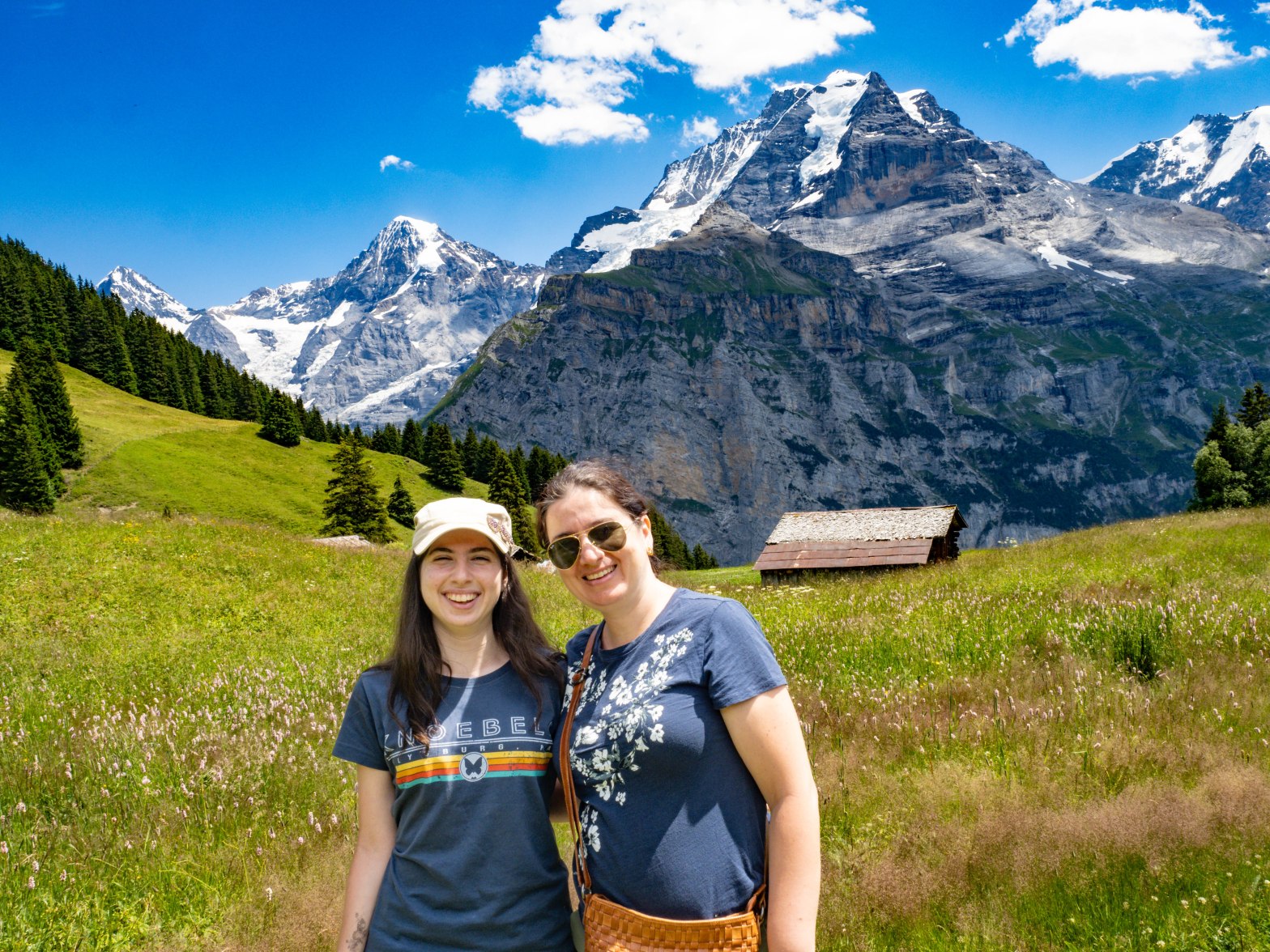
The view from Allmendhubel is indeed impressive.

As with the other mountainscapes, every time we move, the point of view changes and here we have another beautiful landscape 😍!


I’m not entirely sure what is the trail name of our route, we’re pretty much decided to stick with following signs for Mürren (although there were some forks on the way). I think the beginning of the route was a part of North Face Trail in alltrails.com, and some parts were what is marked on Google Maps as Flower Trail. I suspect this name was given to it from the village of Blumental that it goes through. Either way, it is as rich with flowers and butterflies as other trails we visited in the Alps.


This guy turned out to be a spider.

Of course the fact that our way goes near a village also means the landscapes are livened with farms and houses.


We also hear the familiar cowbell sound. Sounds travel far between mountains! We see a couple of herds of cows munching on nearby hills, and some goats.

I have to say, today is getting to be an exceedingly pleasant day. The weather is sunny, a little cooler than yesterday, and while it was a bit hot down in the valley, it is very comfortable here. The walk is beautiful and easy, and the girls are singing the songs from their favorite musicals. They even ask me for my phone to look up the lyrics, but do we have service here in the middle of nowhere? What a silly question, of course we do, we’re in Switzerland 😁!

The trail comes to a stream and becomes steeper and bumpier. The last part goes through a little forest.


We reach Mürren and see a couple of goats having fun on a farm.

The train station and Allmendhubelbahn (the funicular we took upstairs) are on the opposite ends of the town from each other, which means we are sightseeing on the way. Mürren has plenty of cute alpine houses and many residents seem to really know how to grow flowers! Some flower beds are quite impressive, one even has a bed of Edelweisses.
The view of course is also quite good, as we are the closest to the mountains we’ve been.

We take a seat in a restaurant and have another linner. While waiting, I’m snapping pictures of the mountaintops with snowy glaciers.


A curious thing about mountain transportation is you never know when a beautiful view can just open unexpectedly. The trip from Mürren to Lauterbrunnen was particular picturesque.


I said previously that I reserved 3 different hotels for 3 nights, but the thing is, I wasn’t able to find one for us in the Interlaken area for Saturday night. We decided that 2 days would be enough for us here and instead spend the last day near Lake Geneva, particularly in Lausanne. The hotel I found was in Fribourg, and that city seems interesting as well.
Day 13
Fribourg
We did not know much at all about Fribourg until we came here, but, fortunately, much of our little suitcase is taken by various tour guide books…
The first thing of the old city we see is the city wall. In fact the street we are driving on, Rue de Morat (yes, we moved west towards more historically French-speaking areas), passes through the wall through Porte de Morat, the old city gates.
There is a door that one can come in and walk along the wall. The towers can also be visited, but not today, as it is Sunday.


There is a sound of pigeons coming from the wall of the tower. Sure enough, there is a nest in a ventilation hole.

Down from the wall, we drive to the old city center. Rue de Morat ends at a large square but all the street parking is taken. Well, today is Sunday and there is a church plus a cathedral on this square. Fribourg had several monasteries established before the Protestant Reformation, and remained Catholic during it. In fact, there were five more monasteries built here during the Counter-Reformation, which is pretty impressive for a canton firmly jammed between Bern and Vaud (which was occupied by the protestant Bern during these times), and Geneva with Calvin and other protestant leaders nearby. As I said before, it is a wonder that Swiss Confederacy survived the Reformation so well I think.
We park on a little street named Place du Petit-Paradis (which, by the way, sounds pretty funny when pronounced quickly by the navigation system) and find an open cafe right across a square from Hotel de Ville (literally, Rathaus… sorry, City Hall) for our breakfast.

The clock has its own figurines.

Fribourg turned out to be a city on multiple levels, geographically speaking. Sure, we’ve seen cities with hills on our trip, like Lindenhof in Zürich, parts of Geneva old town, and some buildings in Salzburg, all stand above most of their respective cities, but the whole center of Fribourg is on and between two levels, not counting the river. We are currently on the upper level.


Our walk starts with descending to the lower streets via a stairway, then via old streets…


until we reach Pont de Saint Jean, a bridge across Sarine River. Fribourg is proud for its bridges, of which there are five in the old city.


On the square with Fontaine de Saint Jean there is a former barracks building.

We cross the southern part of old Fribourg on the way to another bridge. According to our guide book this part of town was historically more German speaking while most of Fribourg spoke French. I can’t say we notice it in street names though.

The way leads us to Pont du Milieu (Middle Bridge), which offers a different viewpoint at the basilica.

Past the Middle Bridge we are entering a really old part of the city, all paved by cobblestones.


On the place du petit Saint-Jean there is a Saint Anne fountain

We are on a fairly narrow part of land between two curves of the river. The bridge on the other side is Pont de Berne. This one is covered, and looks very old. It is, however, actively used, just like the other bridges here, not only by pedestrians and bicycles, but also by cars and even buses.


There are tons of places here I think where one can get an awesome panorama of the city from the hills on the south side of the river, but we are not going to walk there. We didn’t even know we’ll be here a week ago 😆. What we are doing is getting deeper into the old Fribourg, in the general direction of where we started our walk, and that means going uphill this time 🙄.


There is a church, and some surrounding houses have elaborate decorations.

The slope we’re walking on is actually pretty steep and we are now walked up pretty high.


Another 5 min and the houses change into a fancier neighborhood.


We are approaching the Cathedral from the other side. Today we won’t go in, there is probably a service going on now.

And we’re back to Hotel de Ville, and, soon enough, our parking spot.


The main reason we’re here is because Fribourg is on the way between Interlaken and Lausanne. As such, the drive to Lake Geneva is pretty easy, the weather is good, and there’s an occasional Red Kite in the air.
But instead of going straight to Lausanne, we’re going to drop to Château de Chillon. The road there goes through Montreux, a town on Lake Geneva which appears to be a posh tourist destination, based on the look of some fancy hotels on the main street. This is the type of attractions that interests us only a little bit, and we just glance and drive on.

This area is very busy on this sunny Sunday afternoon, and the road near the castle is filled with cars and buses, parked and moving. We drive back and forth and there doesn’t seem to be a parking spot anywhere. We really don’t want to walk far to the castle, and decide to continue our journey. Château de Chillon wasn’t a must on our list.

Lausanne
Our initial impressions of Lausanne are not great. Frankly, the streets are kind of deserted, most people we see on Place de la Ruponne and nearby are suspiciously looking men. This is also the first place in Switzerland where we detect a smell of urine on the streets 😕. My wild theory that it’s because it’s predominantly French speaking and thus takes after Paris is shattered by the fact that we did not encounter it in Geneva 😁.
Lausanne is a large city, fourth largest in Switzerland, but its historic center, or the part we’re interested in, is fairly small. We start at Palais de Rumine, named in honor of a photographer and engineer Gabriel de Rumine (a son of a Russian duchess and a writer, whose parents left Russia in 1840). He died just 30 years of age in 1871, and left the city of Lausanne 1.5 million dollars to build a public building, which they did. The treaty of Lausanne was signed here.

From here we go uphill through the old town,

take a little rest near Chateau Saint-Maire,

and continue on past attractive old buildings and a very cute cat in a window


until we reach the Lausanne Cathedral


The cathedral, sitting atop a steep hill, is overlooking the city in the direction of the lake.


We take steps going downhill, like we did in Fribourg.

A little photo with Fontaine de la Justice on Place de la Palude pretty much concludes our tour of Lausanne.

We thought the local road along Lake Geneva would offer nice views but we were basically mistaken, almost all of it is blocked by houses and what we did see didn’t compare with what we saw around Lake Thun. Come to think of it, it’s good that the weather forecast made us postpone the Swiss Alps visit until the end of our trip – it may have dampen the impression from other some sights 😁.
Geneva
It’s hot and we already visited two cities today, but we still got a bit of time and stop in Geneva, right near the lake this time, and take a walk along the quay and Jardin Anglais (English Garden).

Besides being tightly packed with people and some bicycles on the land, the quay is teeming with swans, ducks, mergansers and cormorants on the water.

It also provides a very nice outlook to Jet d’Eau

Tamara suggests to go and get close to it, but both me and Anne are not excited – just like big mountains, it is better viewed from a little distance. I think its big attraction right now is getting splashed by it in such a heat. Eh, not worth it walking all the way through the sunshine for that. It’s better to get an ice-cream (if you are Toma or Anne) or beer (if you’re me) and watch the fountain making rainbow from the shade .

That’s it. Almost two weeks of walking through cities, towns, hills and mountains are over. Our hotel for tonight is very close to the airport, just right for a morning flight. As they say it in Switzerland, “auf wiedersehen” or “au revoir”. Of course they can apparently say “arrivederci”, which would also be in an official language of Switzerland, but we haven’t heard it here 😄.
 Our travel blog